Which State Has the Cheapest IVF? Costs, Laws, and Where to Get the Best Value in 2025
 Dec, 1 2025
IVF Cost Estimator
Calculate Your IVF Costs
Cost Comparison by State
Michigan
$8,500 base cost
No insurance mandate
Includes one transfer & PGT-A
North Carolina
$9,200 base cost
No insurance mandate
Includes one transfer
Tennessee
$9,700 base cost
No insurance mandate
Includes one transfer
IVF isn’t just expensive-it’s one of the most financially stressful medical procedures a person can go through. In the U.S., a single cycle of IVF typically costs between $12,000 and $17,000, not including medications, which can add another $3,000 to $5,000. For many, that’s more than a year’s rent. So when people ask, which state has the cheapest IVF, they’re not just looking for a number-they’re looking for a lifeline.
Where IVF Costs the Least in the U.S.
As of 2025, the state with the lowest average IVF cost is Michigan. Clinics in Detroit, Grand Rapids, and Ann Arbor offer bundled packages starting at $8,500 for a fresh cycle without medication. That’s nearly 30% lower than the national average. Why? Michigan has no state mandate requiring insurers to cover IVF, so clinics compete harder on price. Many offer payment plans, discounts for multiple cycles, and free consultations to attract patients from neighboring states like Ohio and Illinois.
Right behind Michigan is North Carolina, where clinics in Raleigh and Chapel Hill average $9,200 per cycle. The state has a strong network of university-affiliated fertility centers that keep overhead low and focus on efficiency. Some clinics there even include one frozen embryo transfer in the base price-a rare perk.
Other affordable options include Ohio ($9,500), Tennessee ($9,700), and Georgia ($9,800). These states don’t have high insurance mandates, and many clinics are located in mid-sized cities with lower rent and operating costs than coastal metros.
States Where IVF Costs the Most
On the other end of the spectrum, California and New York are the most expensive. In Los Angeles and San Francisco, you’re looking at $18,000 to $22,000 per cycle. Why? High real estate costs, strict state regulations, and high demand from affluent patients drive prices up. Even though California requires insurers to cover IVF for some patients, that doesn’t lower the out-of-pocket cost for those without qualifying coverage.
New York has similar issues. While the state mandates coverage for some employers, many clinics charge premium rates because they’re located in high-cost urban centers. Medications alone can cost $6,000 in NYC, compared to $3,500 in Detroit.
What Drives the Price Differences?
It’s not just location-it’s what’s built into the price. A $9,000 package in Michigan might include:
- Initial consultation and bloodwork
- Ultrasounds and monitoring
- Medication protocol guidance
- EGG retrieval and lab work
- One fresh embryo transfer
But in California, the same $9,000 might only cover monitoring and retrieval. The transfer? That’s extra. So always ask: What’s included? Many clinics in cheaper states offer all-inclusive pricing to avoid surprise bills.
Another factor: medication costs. In states with no insurance mandates, clinics often partner with discount pharmacy programs. In Michigan, patients can get fertility drugs through mail-order pharmacies for as low as $1,200 per cycle. In contrast, in states like Massachusetts, where insurance must cover meds, patients still pay $4,000-$5,000 because the system is structured around high-cost providers.
Insurance and State Mandates Matter-But Not How You Think
People assume that states requiring insurance to cover IVF will make it cheaper. That’s not always true. States like Illinois, New Jersey, and Massachusetts have strong mandates, but they often only apply to large employers. If you work for a small business or are self-employed, you’re on your own.
Meanwhile, states like Michigan and Tennessee have no mandates-but because clinics know patients can’t rely on insurance, they’ve built affordable, transparent pricing models to survive. The result? Lower out-of-pocket costs for most people.
Here’s a quick breakdown of how state laws affect real-world pricing:
| State | Avg. IVF Cost (without meds) | Insurance Mandate? | Typical Patient Out-of-Pocket |
|---|---|---|---|
| Michigan | $8,500 | No | $8,500-$11,000 |
| North Carolina | $9,200 | No | $9,200-$12,000 |
| Ohio | $9,500 | Partial | $9,500-$13,000 |
| California | $18,000 | Yes (for large employers) | $15,000-$22,000 |
| New York | $17,500 | Yes (limited) | $16,000-$23,000 |
| Tennessee | $9,700 | No | $9,700-$12,500 |
Hidden Costs That Can Double Your Bill
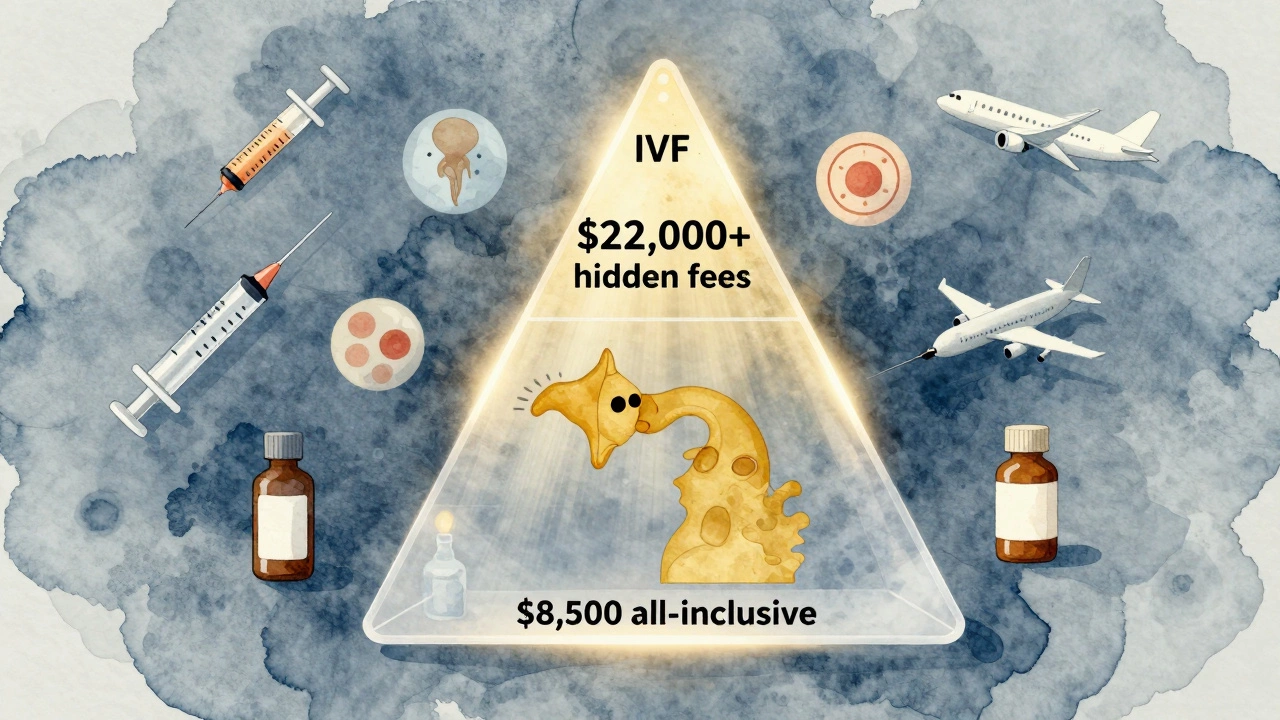
Many patients get shocked when their final bill is twice what they were quoted. Why? Because clinics often don’t include these:
- Medications: $3,000-$6,000
- Genetic testing (PGT-A): $3,000-$5,000
- Additional embryo transfers: $2,000-$4,000 each
- Storage fees: $500-$1,000/year
- Donor eggs or sperm: $15,000-$30,000 extra
Always ask for a total out-of-pocket estimate-not just the base procedure cost. In Michigan, some clinics include PGT-A and one frozen transfer in their $9,000 package. In New York, you’d pay $14,000 for the same thing.
What About Traveling for IVF?
If you live in a high-cost state, traveling for treatment can save you $5,000 to $10,000. Many patients from New York, New Jersey, and California fly to Michigan or North Carolina for treatment. The travel cost? Often under $1,000 round-trip. Add a week’s hotel stay and meals, and you’re still $7,000 ahead.
Some clinics even offer “IVF travel packages” that include airport pickup, discounted hotel rates, and same-day appointments. One clinic in Ann Arbor reports that 40% of their patients are from out of state.
How to Find the Best Deal
Don’t just pick the cheapest clinic. Look for these signs of value:
- Transparent pricing: The website lists all costs upfront, no fine print.
- Guaranteed refunds: Some clinics offer partial refunds if the cycle fails.
- Package deals: Multiple cycles at a discounted rate.
- Medication assistance programs: Free or discounted drugs through partnerships.
- Success rates published: Look for live birth rates per transfer-not just pregnancy rates.
Check the CDC’s Assisted Reproductive Technology (ART) Success Rates database. It’s the only federally tracked source. Don’t trust clinic marketing claims.

What If You Can’t Afford IVF at All?
Even in the cheapest states, IVF is out of reach for many. Here’s what you can do:
- Apply for grants: Organizations like Resolve: The National Infertility Association offer $2,000-$5,000 grants.
- Use FSA/HSA: You can use pre-tax dollars from these accounts to pay for IVF.
- Ask for payment plans: Most clinics offer 6-24 month plans with 0% interest.
- Consider donor eggs: If you’re over 38, donor egg cycles in Michigan cost $18,000-$22,000-but success rates jump to 60%+.
One patient from Chicago saved $11,000 by traveling to Grand Rapids. She got two cycles for the price of one in Illinois. Her success? A healthy baby at age 40.
Final Advice: Don’t Just Chase the Lowest Price
Cheapest doesn’t always mean best. A clinic in Michigan might charge $8,500, but if their live birth rate is 25%, you might need three cycles. A clinic in North Carolina charging $9,500 with a 45% success rate could save you money in the long run.
Compare cost per live birth, not just cost per cycle. That’s the real metric.
And if you’re serious about IVF, call three clinics in your target state. Ask for a written quote. Ask what’s included. Ask about refunds. Ask about medication discounts. Don’t trust email quotes-get it on paper.
There’s no magic state where IVF is free. But in 2025, Michigan, North Carolina, and Tennessee offer the best combination of low cost, high transparency, and decent success rates. If you’re willing to travel a few hours, you can cut your IVF bill in half-and keep more of your savings for the baby clothes.
Is IVF cheaper in other countries than in the U.S.?
Yes, in countries like Mexico, India, and the Czech Republic, IVF can cost $3,000-$6,000. But travel, language barriers, legal issues, and lack of follow-up care add risks. U.S. clinics offer better legal protections, standardized lab quality, and continuity of care. For most, the safety and reliability of U.S.-based treatment outweigh the lower international price.
Does Medicaid cover IVF in any state?
No. Medicaid never covers IVF in any U.S. state. Some states cover fertility diagnostics or intrauterine insemination (IUI), but IVF is always out-of-pocket. This is why affordable private clinics are so important-they fill the gap left by public insurance.
Can I use my HSA for IVF?
Yes. The IRS considers IVF a qualified medical expense, so you can use HSA or FSA funds to pay for it. This includes medications, procedures, storage fees, and even travel if it’s directly related to treatment. Keep receipts-you’ll need them for tax purposes.
Why are IVF prices so different between clinics in the same state?
It comes down to overhead, experience, and business model. University hospitals often charge more because they handle complex cases and do research. Private clinics focus on volume and efficiency. Some clinics include PGT-A or frozen transfers; others don’t. Always compare what’s included-not just the headline price.
Are there any states where IVF is legally restricted?
As of 2025, no state bans IVF. But some have laws affecting embryo storage, donor egg use, or surrogacy. For example, Louisiana has strict rules on embryo disposal, which can affect how clinics handle unused embryos. Always ask about state-specific legal limits before choosing a clinic.
Next Steps: What to Do Today
If you’re considering IVF and want the best value:
- Make a list of 3-5 clinics in Michigan, North Carolina, or Tennessee.
- Call each one and ask for a written, itemized quote.
- Ask for their CDC-reported success rates for your age group.
- Compare total cost per live birth, not per cycle.
- Apply for grants from Resolve or local nonprofits.
Don’t wait for insurance. Don’t assume your state is the cheapest. Do the math. Travel if you have to. The right clinic can turn a $20,000 burden into a $10,000 investment-with a baby to show for it.